
Table of Contents
- Can Toddlers Learn to Play Piano?
- Understanding Musical Play vs. Formal Lessons
- Signs a Child Is Ready for Piano Lessons
- Toddler Piano Activities You Can Do at Home
- How Long Should Toddlers Practice Piano?
- Choosing a Piano Teacher for a Young Child
- Setting Up a Safe, Comfortable Piano Space
- What to Expect: Progress and Realistic Milestones
Last Updated: October 18, 2026
Can Toddlers Learn to Play Piano?
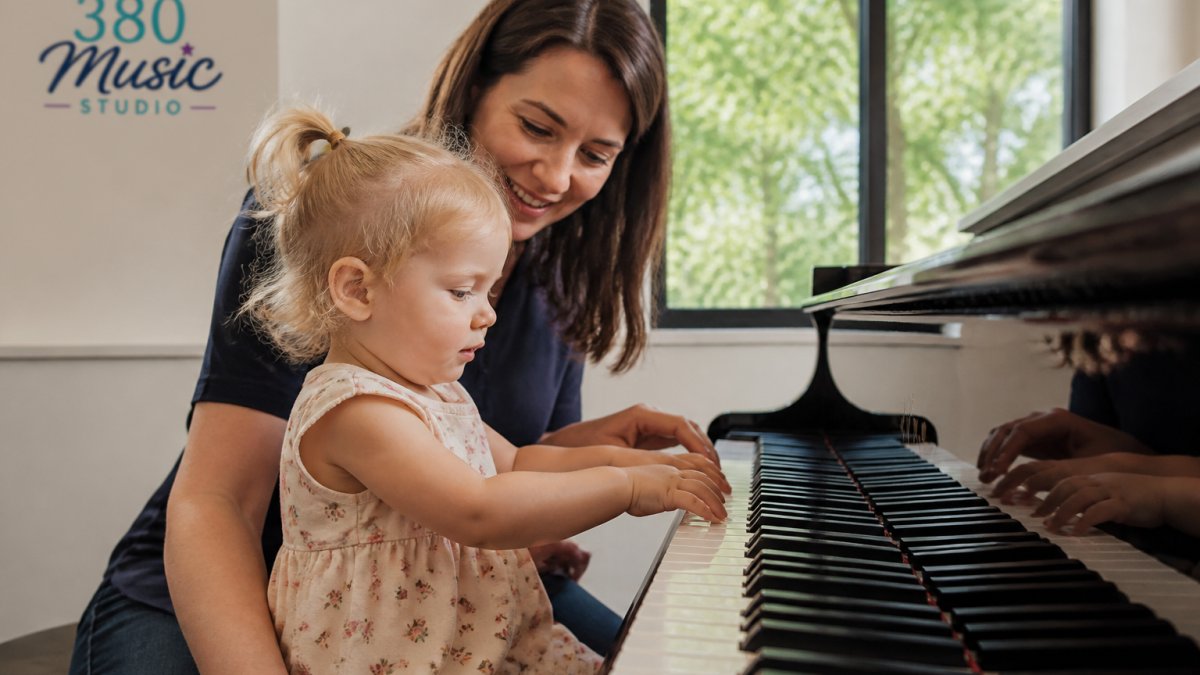
Yes, can toddlers learn to play piano? Absolutely, through exploration and guided musical play. At 380 Music Studio, we work with young children to introduce them to music in ways that match their developmental stage.
Most toddlers between ages 2 and 4 aren’t ready for formal, structured lessons the way older children are. But that doesn’t mean they can’t start building a relationship with music and the piano. Early exposure helps develop listening skills, rhythm awareness, and a genuine love of music. These are all signs they’re ready to explore.
The key difference is how we approach it. Instead of sitting down to practice scales or learn to read music, toddlers benefit from playful exploration. They touch keys, listen to sounds, move their bodies, and sing along. A skilled teacher guides this play in ways that build musical foundations without pressure or frustration.
Understanding Musical Play vs. Formal Lessons
Musical play is what toddlers naturally do when they encounter a piano. They press keys to hear sounds, experiment with different pitches, and enjoy the cause-and-effect of their actions. This is exploration, not instruction.
Formal lessons involve structured learning: sitting at a specific time, following a curriculum, learning to read music, and practicing specific skills.
The real value for toddlers lies somewhere in between.
Here’s what makes the difference: a teacher helps a toddler notice patterns in sound, encourages them to listen carefully, and celebrates their discoveries. This guided play teaches more than unstructured tinkering alone.
At 380 Music Studio, we work with young children by meeting them where they are developmentally. We don’t push toddlers to sit still for 30 minutes or memorize music theory. Instead, we create moments where music feels exciting and natural.
Signs a Child Is Ready for Piano Lessons
Not every toddler is ready at the same age. Readiness depends on more than just age, it’s about attention span, interest, coordination, and personality.
Look for these signs:
- Your child shows genuine interest in the piano or keyboard
- They can sit still for at least 10-15 minutes, even if not perfectly
- They follow simple instructions (“Play the black key,” “Listen to this sound”)
- They enjoy music and moving to rhythm
- They have some fine motor control (can grasp small objects, point with one finger)
- They’re curious about sounds and want to explore
Not all toddlers show these signs at the same age. Some 2-year-olds are fascinated by music and ready to explore. Others aren’t interested until age 4 or 5. Both are completely normal.
When to wait:
If your toddler is easily frustrated, can’t sit for more than a few minutes, or shows no interest in music, that’s okay. Forcing lessons before they’re ready often backfires. A good teacher can help you decide. Sometimes waiting a few months makes a huge difference in how much your child enjoys and benefits from lessons.
Toddler Piano Activities You Can Do at Home
You don’t need a teacher to start exploring piano with your toddler at home. Simple, playful activities build musical awareness and keep your child engaged.

Ages 2-3: Exploration and Sound Discovery
At this age, toddlers are fascinated by cause and effect. They love pressing keys and hearing sounds. Keep activities short, just 5-10 minutes.
Simple activities:
- Let your toddler press any keys they want and listen
- Play a single key repeatedly and ask them to copy the sound
- Play high notes and low notes, then ask which is which
- Sing a simple song while your toddler plays keys randomly
- Make animal sounds together (“What sound does a cow make?”) then find similar sounds on the piano
- Play a key, then pause and let your toddler press the same key
The goal is joy and curiosity, not accuracy. Your toddler is learning that they can make music happen.
Ages 3-4: Building Rhythm and Listening Skills
As toddlers get older, they can focus a bit longer and follow simple patterns. Activities become slightly more structured, but still playful.
Simple activities:
- Clap a simple beat, then have your toddler copy it
- Play a steady beat on one key while your toddler sings or dances
- Play a short melody twice and ask if it’s the same or different
- Find matching keys (play a key, then help your toddler find the same key)
- Play a pattern like “high-low-high” and have your toddler repeat it
- Sing a familiar song while your toddler plays any keys that feel right
At this stage, your toddler is starting to notice patterns and develop listening skills. They’re building the foundation for more structured learning later.
How Long Should Toddlers Practice Piano?
Toddlers have short attention spans. That’s not a limitation, it’s developmentally normal and actually a clue about what works best.
Realistic practice times:
- Ages 2-3: 2-5 minutes, a few times a week
- Ages 3-4: 5-10 minutes, a few times a week
- Ages 4-5: 10-15 minutes, three-five times a week
Quality matters far more than quantity. Ten minutes of engaged, joyful exploration teaches more than 30 minutes of forced practice. A toddler who loves those 10 minutes will come back tomorrow excited. A toddler forced to sit for 30 minutes might avoid the piano altogether.
The best approach is frequent, short sessions. Your toddler practices for a few minutes, then moves on. This keeps music fun and prevents frustration. As they grow older and their attention span expands, practice naturally becomes longer.
Your toddler’s teacher can help you figure out what works for your child’s personality and schedule. Some kids do best with daily 10-minute sessions. Others thrive with three longer sessions a week. The right amount depends on your child, not on a fixed rule.
Choosing a Piano Teacher for a Young Child
Not every piano teacher is suited to work with toddlers. Young children need a different approach than older students.
What to look for:
- Experience working with toddlers and preschool-aged children
- A playful, patient teaching style that meets children where they are
- Flexibility with structure (willing to follow your child’s lead sometimes)
- Clear communication about realistic expectations for young learners
- A warm, encouraging approach that builds confidence
- Ability to adapt lessons based on your child’s mood and energy level
At 380 Music Studio, our teachers understand early childhood development. We know that a 3-year-old learns differently than an 8-year-old. We use age-appropriate activities, keep sessions playful, and focus on building a love of music rather than perfect technique.
When you’re choosing a teacher, ask about their experience with young children. Ask how they keep toddlers engaged. Ask what a typical lesson looks like. A good teacher will explain their approach and help you understand what your child will experience.
The right teacher makes all the difference. A teacher who understands toddlers can turn piano exploration into genuine learning while keeping it fun.
Setting Up a Safe, Comfortable Piano Space
Your toddler needs a setup that’s safe, comfortable, and encourages exploration.
Essential setup:
- A sturdy keyboard or small piano that won’t tip over
- A bench or stool at the right height (your toddler’s elbows should be at about keyboard level)
- Enough space around the piano so your toddler can move freely
- Good lighting so your child can see the keys clearly
- A quiet space where your toddler can focus
Safety considerations:
- Make sure the piano is stable and won’t shift if your toddler leans on it
- Check that there are no sharp edges or pinch points
- Keep the area clear of toys or objects that could distract
- Position the piano away from high-traffic areas in your home
- Ensure your toddler can get on and off the bench safely
A comfortable setup matters. If your toddler’s feet dangle and they can’t reach the pedals (which they won’t use anyway), they’ll be uncomfortable and distracted. If the bench is too high or too low, they’ll develop poor posture habits. Getting these basics right removes barriers to enjoying the piano.
What to Expect: Progress and Realistic Milestones
Progress looks different for toddlers than for older students. Understanding realistic milestones helps you celebrate the right things and avoid frustration.
Ages 2-3, you might see:
- Your toddler recognizes the piano and gets excited to explore it
- They press keys with more intention and listen to the sounds
- They can follow simple one-step instructions (“Play this key”)
- They enjoy making sounds and experimenting
- They start to recognize familiar songs by ear
Ages 3-4, you might see:
- Your toddler can copy simple patterns (high-low-high)
- They recognize some songs and try to play them
- They develop better finger control and coordination
- They sit longer and focus better
- They start to understand that different keys make different sounds
- They enjoy singing along while playing
What not to expect:
- Reading music fluently
- Playing full songs accurately
- Long practice sessions
- Perfect technique or posture
- Memorizing pieces
These things come later, as your child’s brain and body develop. Pushing toddlers toward these milestones too early creates frustration for everyone. The real win at this stage is building confidence, curiosity, and a genuine love of music.
A skilled teacher tracks your toddler’s progress and helps you understand what’s developmentally appropriate.
|
Milestone |
Ages 2-3 |
Ages 3-4 |
What It Means |
|---|---|---|---|
|
Attention span |
5-10 minutes |
10-15 minutes |
Your child is developing focus and patience |
|
Sound exploration |
Random pressing |
Intentional listening |
They’re learning cause-and-effect and discrimination |
|
Following instructions |
Simple, one-step |
Two-step instructions |
Cognitive development is expanding |
|
Fine motor control |
Whole hand pressing |
Individual finger use |
Coordination is improving |
|
Musical awareness |
Enjoying sounds |
Recognizing patterns |
Listening skills are developing |
The truth is simple: toddlers can absolutely learn to play piano. But learning at this age looks nothing like what you might imagine. It’s messy, playful, and full of exploration.
At 380 Music Studio, we believe every child deserves to experience the joy of making music, regardless of age. If your toddler is showing interest in piano, we’d love to talk with you about what that could look like.